
The Fermanagh and South Tyrone Green Party
Sunday, 2 March 2014

Next meeting
Our next meeting will be held on Wednesday 12th March at 6pm in the bar
of the Horseshoe & Saddlers, Enniskillen. New and prospective
members are very welcome.
Tuesday, 18 February 2014
Next meeting
Our next meeting will be held on Wednesday 26th February at 6pm in the bar
of the Horseshoe & Saddlers, Enniskillen. New and prospective
members are very welcome.
Saturday, 1 February 2014
Next meeting
Our next meeting will be held on Wednesday 12th February at 6pm in the bar
of the Horseshoe & Saddlers, Enniskillen. New and prospective
members are very welcome.
Wednesday, 15 January 2014
Next meeting
Our next meeting will be held on Wednesday 22nd January at 6pm in the bar
of the Horseshoe & Saddlers, Enniskillen. New and prospective
members are very welcome.
Wednesday, 27 November 2013
Religion and the environment
You shall
not defile the land
by Laurence Speight
We
are so embedded in our culture, so focused on attending to the necessities of
daily life that we are often blind to the contradictions between our declared values
and beliefs and how we live. This disconnect in regard to the religious became
apparent to me on observing the enormous amount of car parking space churches
provide for their faithful. At one Catholic Church I counted 280 spaces. This
is on a par with what the big supermarkets provide for their customers. Adjacent
to the car park was an almost equal amount of land reserved for the deceased.
Car
parking space of supermarket proportions encourages the use of the private car,
which makes a major contribution to global warming leading in turn to the
extinction of life and the collapse of ecosystems. Undermining ecology
multiplies the suffering of the poorest of humanity. Yet, one would have
thought that of all the different groups in society the religious would
exemplify a life of care and respect for nonhuman nature as destroying it desecrates
the handiwork of God. This is clearly stated in the primary texts of the major
religions. The Book of Numbers in the Christian bible states that the Earth is
sacred and should not be polluted or defiled. Numbers 35: 33-34 advices:
“You shall not pollute the land in which you
live .... You shall not defile the land in which you live, in which I also
dwell.”
The
ethic of respect for nonhuman nature is repeated throughout the bible often
accompanied by the scientifically supported warning that if the Earth is
defiled humankind will suffer the consequences. Further, God proclaims that all
animals, inclusive of Homo sapiens, have equal merit. In Ecclesiastes 3:19 we
are told:
“For the fate of humans and the fate of
animals is the same; as one dies, so dies the other. They all have the same
breathe, and humans have no advantage over the animals, for all is vanity. All
go to one place, all are from the dust, and all return to dust.”
Contrary
to God’s explicitly expressed directive about how humans should interact with
nonhuman nature, and the revered status with which it should be held, the main religions
have traditionally regarded other life forms as mere utility. This hubris has
brought catastrophe to the planet and may lead to what many dare not
contemplate our early extinction. That we are doing practically nothing to
address global warming suggests this might be the outcome.
A
change in our attitude towards nonhuman nature is possible. In Pope Francis’s
recent interview with the editor of La Civitta Cattolica
(americanmagazine.org/pope-interview) he gives a distinctly ecological view of
human relations saying:
“No one is saved alone, as an isolated
individual, but God attracts us looking at the complex web of relationships that
take place in the human community. God enters this dynamic, this participation
in the web of human relationships.”
Although
the pope also spoke of “God in creation”
and “love of all things in God” which
implicitly means all life, from microbes to Giant Redwood Trees, is
sacred. What the pontiff unfortunately
did not do to do was ask the faithful to live in an environmentally sustainable
way so as not to desecrate the sacred, unstring the interconnecting web of
biodiversity Catholics believe God created. On the eve of the publication of
the International Panel on Climate Change’s new report (27.09) this was a missed
opportunity, unless his extolling the virtues of living “on the frontier” was a message to the faithful to do so.
Sunday, 10 November 2013
Next meeting
Our next meeting will be held on Thursday 14th November at 6pm in the bar
of the Horseshoe & Saddlers, Enniskillen. New and prospective
members are very welcome.
Global Frackdown Day

Spreading the word in Enniskillen town centre on Global Frackdown Day, October 2013.
Thursday, 10 October 2013
Next meeting
Our next meeting will be held on Thursday 17th October at 6pm in the bar
of the Horseshoe & Saddlers, Enniskillen. New and prospective
members are very welcome.
Sunday, 1 September 2013
Next meeting - AGM
Our next meeting, which will be our 2013 AGM, will be held on Thursday 26th September at 6pm in the bar
of the Horseshoe & Saddlers, Enniskillen. New and prospective
members are very welcome.
Thursday, 25 July 2013


The Emperor Is Wearing No Clothes
Lawrence Speight
The twenty-four hour G8 Summit in County Fermanagh cost £80 million including £60 million for security. It is sobering to think that if the leaders were engaged with G8 business for 10 hours each hour cost £8 million. In consideration of the social and environmental projects this money could have been spent on one has to ask was the summit value for money. The small economy of Northern Ireland has to pay £20 million of the cost.
The purpose of the summit was for the G8 leaders to address the urgent problems of the day. These included the war in Syria, global hunger and tax avoidance by the rich and powerful.
The summit highlights the failed approach taken by our political institutions which rely on a combination of constitutional constructs and illusions to sustain them. One of the illusions is those with political power have insightful understanding. Another is that the compassion of national leaders is not circumscribed by party, ethnic or national loyalties or desire for egoistical gain. A third illusion is political leaders can change the cultural milieu and thereby make positive things happen. These illusions help explain the widespread adulation the G8 leaders received on their short visit to Northern Ireland.
Evidence for the prevalence of these illusions is that global warming was not on the G8 agenda. Insightfulness and compassion would have ensured otherwise. Most of the G8 leaders came to the summit with a fixed remedy for the war in Syria, which is to give the combatants more guns, missiles and ammunition. None had any intention of addressing the unjust structural relationships that underpin world hunger. The idea that robust measures should be put in place to ensure that the rich pay a fair tax is an anathema to the G8. Research by the Tax Justice Network shows that global tax evasion could be costing more than 2.5 trillion Euro a year, and that as much as 26 trillion Euros could be hidden by individuals in tax havens. (Editorial, Irish Times, 17.06) Arthur Beesley in his analysis of the summit in The Irish Times (18.06) writes: “When Obama arrived in the White House in 2009 there was plenty of talk about resolute action to take more tax from big business. Four years later, this is still in the realm of talk.” In this light the £300 million summit was a photo opportunity for the G8 leaders.
The key political problem of our age, and which should have been on the G8 agenda, is how to manage abundance. The fact that three million children die of hunger each year, and one in eight of the world’s population goes to bed hungry every night is not because of a perennial food shortage. U.N. figures show that half of the food produced world-wide is wasted before it gets to the shops and the affluent throw one third of the food they buy into the bin. As Terry Eagleton writes in The Guardian Review, 29.06, “Widespread hunger is the result of predatory social systems.”
Most of the problems humanity faces, including lack of sanitation, health services and education for the billions who are destitute could be solved by a small percentage of the money spent on wars and preparation for war. The following figures illustrate this. Brown University’s Watson Institute for International Studies calculates that the United States has spent $6 trillion on its wars in Iraq, Afghanistan and Pakistan. The US, National Priorities Project, estimates that since 2001 the United States has spent $1,450,427,500,000 on wars. The Today programme, Radio 4, 28.06, estimates that the UK has spent £40 billion on the war in Afghanistan. The Stockholm Peace Institute’s figure for worldwide military expenditure in 2012 is $1.75 trillion. If the G8 leaders had agreed to progressively reduce their military budgets the summit would have been worth the expense.
War and our destruction of the environment are a form of self-harm rooted in our lack of imagination. When it comes to the economy, we cannot imagine any model other than that of growth. When it comes to energy we cannot imagine anything but fossil fuels. With food we cannot image any system but oil-based monoculture, which in the case of soya and palm oil leads to the destruction of rainforests - the rain clouds and lungs of the Earth.
Hope for a deep rooted and widespread eco-consciousness, as well as a nonviolent approach to conflict, lies in that most people know that 2 multiplied by 2 does not equal 5 as in the logic of orthodox economics. The millions demonstrating on the streets of Brazil, Egypt and Turkey against institutional corruption, the 5,000 anti-G8 demonstrators in Belfast and 2,000 in Enniskillen, as well as the occupy-movement, the transitional towns movement, the long waiting lists in every town and city on these islands for allotments, and the work of such agencies as Oxfam, War On Want, Christian Aid and Trocaire is hope that a critical mass will act on the realisation that “the emperor is wearing no clothes”. It is time for a new paradigm.
The twenty-four hour G8 Summit in County Fermanagh cost £80 million including £60 million for security. It is sobering to think that if the leaders were engaged with G8 business for 10 hours each hour cost £8 million. In consideration of the social and environmental projects this money could have been spent on one has to ask was the summit value for money. The small economy of Northern Ireland has to pay £20 million of the cost.
The purpose of the summit was for the G8 leaders to address the urgent problems of the day. These included the war in Syria, global hunger and tax avoidance by the rich and powerful.
The summit highlights the failed approach taken by our political institutions which rely on a combination of constitutional constructs and illusions to sustain them. One of the illusions is those with political power have insightful understanding. Another is that the compassion of national leaders is not circumscribed by party, ethnic or national loyalties or desire for egoistical gain. A third illusion is political leaders can change the cultural milieu and thereby make positive things happen. These illusions help explain the widespread adulation the G8 leaders received on their short visit to Northern Ireland.
Evidence for the prevalence of these illusions is that global warming was not on the G8 agenda. Insightfulness and compassion would have ensured otherwise. Most of the G8 leaders came to the summit with a fixed remedy for the war in Syria, which is to give the combatants more guns, missiles and ammunition. None had any intention of addressing the unjust structural relationships that underpin world hunger. The idea that robust measures should be put in place to ensure that the rich pay a fair tax is an anathema to the G8. Research by the Tax Justice Network shows that global tax evasion could be costing more than 2.5 trillion Euro a year, and that as much as 26 trillion Euros could be hidden by individuals in tax havens. (Editorial, Irish Times, 17.06) Arthur Beesley in his analysis of the summit in The Irish Times (18.06) writes: “When Obama arrived in the White House in 2009 there was plenty of talk about resolute action to take more tax from big business. Four years later, this is still in the realm of talk.” In this light the £300 million summit was a photo opportunity for the G8 leaders.
The key political problem of our age, and which should have been on the G8 agenda, is how to manage abundance. The fact that three million children die of hunger each year, and one in eight of the world’s population goes to bed hungry every night is not because of a perennial food shortage. U.N. figures show that half of the food produced world-wide is wasted before it gets to the shops and the affluent throw one third of the food they buy into the bin. As Terry Eagleton writes in The Guardian Review, 29.06, “Widespread hunger is the result of predatory social systems.”
Most of the problems humanity faces, including lack of sanitation, health services and education for the billions who are destitute could be solved by a small percentage of the money spent on wars and preparation for war. The following figures illustrate this. Brown University’s Watson Institute for International Studies calculates that the United States has spent $6 trillion on its wars in Iraq, Afghanistan and Pakistan. The US, National Priorities Project, estimates that since 2001 the United States has spent $1,450,427,500,000 on wars. The Today programme, Radio 4, 28.06, estimates that the UK has spent £40 billion on the war in Afghanistan. The Stockholm Peace Institute’s figure for worldwide military expenditure in 2012 is $1.75 trillion. If the G8 leaders had agreed to progressively reduce their military budgets the summit would have been worth the expense.
War and our destruction of the environment are a form of self-harm rooted in our lack of imagination. When it comes to the economy, we cannot imagine any model other than that of growth. When it comes to energy we cannot imagine anything but fossil fuels. With food we cannot image any system but oil-based monoculture, which in the case of soya and palm oil leads to the destruction of rainforests - the rain clouds and lungs of the Earth.
Hope for a deep rooted and widespread eco-consciousness, as well as a nonviolent approach to conflict, lies in that most people know that 2 multiplied by 2 does not equal 5 as in the logic of orthodox economics. The millions demonstrating on the streets of Brazil, Egypt and Turkey against institutional corruption, the 5,000 anti-G8 demonstrators in Belfast and 2,000 in Enniskillen, as well as the occupy-movement, the transitional towns movement, the long waiting lists in every town and city on these islands for allotments, and the work of such agencies as Oxfam, War On Want, Christian Aid and Trocaire is hope that a critical mass will act on the realisation that “the emperor is wearing no clothes”. It is time for a new paradigm.
Tuesday, 16 July 2013
Next meeting
Our next meeting will be held on Thursday 25th July at 6pm in the bar
of the Horseshoe & Saddlers, Enniskillen. New and prospective
members are very welcome.
Thursday, 4 April 2013
Lucifer’s Sin
Lawrence Speight
We tend to think of ourselves as the alpha species, somewhat akin to the iconic frontiers people of the American West; a species that can forge its own destiny without reference to or dependency on others. There are grounds for this view.
We have brought much of what we have conceived in our imagination to life. By means of high-speed trains and airplanes we can travel great distances in short periods of time, smart phones enable us to see and talk to each other across oceans and continents almost as if we were feet apart. Through organ transplants we can prevent what were once inevitable deaths. We have eradicated the scourge of smallpox and are close to doing the same with polio. We can eat the choicest foods, produced in every climate, at any time, by way of our local supermarket. This is a feat beyond what the richest monarch could ever have enjoyed. We can carry out micro-surgery and study planets and stars billions of miles away. Military personnel can kill people in deserts and on mountainsides in far away countries without exposing themselves to danger. Some governments, including the United Kingdom, can commit the ultimate terrorist act and eliminate hundreds of millions of people at the press of a button.
With the exception of the poor and the persecuted, people in the early part of the 21st century have the powers described in classical mythologies. We are the personification of ancient Gods. However, we have a fatal flaw, we believe our illusions.
Perhaps our most harmful illusion is the belief that our technosphere is an entity set apart from the biosphere, that our culture is its own self-sustaining cosmos. We are so imbued with this idea that we elect governments that subsidise the destruction of the very means of our existence, believing, as politicians often say that “it is the right thing to do.” Rainforests, the site of the most varied biodiversity on the planet, described as the Earth’s lungs, are clear-felled with the help of government subsidies in order for companies to grow palm oil. Soil, which purifies and regulates our water supply, provides us with over 90% of the food we eat, along with timber, fibre and bio-fuels, is washed into rivers by poor farming methods at a rate faster than it can be replenished. Great expanses of sea have been turned into dead zones through agreements that ignore research findings on sustainable fishing. Although the link between burning fossil fuels and climate chaos is now as widely accepted as the link between inhaling cigarette smoke and lung cancer, companies are given permission by governments, and money by banks, to build ever more coal-fired power stations as well as extract oil and gas from the ground regardless of local conditions.
The evidence of how we manage our relationship with nonhuman nature suggests we have not found our niche in the web of life and are thus destined for a short life-span. Given the rapidity with which we are cannibalizing the Earth is it realistic to think that our species, which has existed for a mere 200,000 years, will see the sun rise 10 million years from now, which is the average life-span of a species? What are the chances of us surviving as long as the elephant, 60 million years, the crocodile, 80 million years, or the turtle which in the course of its 150 million years saw the dinosaurs evolve and become extinct?
I suspect most people would feel offended by the idea that many nonhuman life-forms are likely to outlive humankind and continue to evolve over the one billion years our Garden of Eden is expected to sustain life. By way of our illusions we are evicting ourselves from paradise, truly the fallen species having committed Lucifer’s sin, hubris - preoccupation with self. Taking the wellbeing of other species and the health of ecosystems into account when we make decisions, and undertaking environmental restoration work, is one way we can find redemption.
We tend to think of ourselves as the alpha species, somewhat akin to the iconic frontiers people of the American West; a species that can forge its own destiny without reference to or dependency on others. There are grounds for this view.
We have brought much of what we have conceived in our imagination to life. By means of high-speed trains and airplanes we can travel great distances in short periods of time, smart phones enable us to see and talk to each other across oceans and continents almost as if we were feet apart. Through organ transplants we can prevent what were once inevitable deaths. We have eradicated the scourge of smallpox and are close to doing the same with polio. We can eat the choicest foods, produced in every climate, at any time, by way of our local supermarket. This is a feat beyond what the richest monarch could ever have enjoyed. We can carry out micro-surgery and study planets and stars billions of miles away. Military personnel can kill people in deserts and on mountainsides in far away countries without exposing themselves to danger. Some governments, including the United Kingdom, can commit the ultimate terrorist act and eliminate hundreds of millions of people at the press of a button.
With the exception of the poor and the persecuted, people in the early part of the 21st century have the powers described in classical mythologies. We are the personification of ancient Gods. However, we have a fatal flaw, we believe our illusions.
Perhaps our most harmful illusion is the belief that our technosphere is an entity set apart from the biosphere, that our culture is its own self-sustaining cosmos. We are so imbued with this idea that we elect governments that subsidise the destruction of the very means of our existence, believing, as politicians often say that “it is the right thing to do.” Rainforests, the site of the most varied biodiversity on the planet, described as the Earth’s lungs, are clear-felled with the help of government subsidies in order for companies to grow palm oil. Soil, which purifies and regulates our water supply, provides us with over 90% of the food we eat, along with timber, fibre and bio-fuels, is washed into rivers by poor farming methods at a rate faster than it can be replenished. Great expanses of sea have been turned into dead zones through agreements that ignore research findings on sustainable fishing. Although the link between burning fossil fuels and climate chaos is now as widely accepted as the link between inhaling cigarette smoke and lung cancer, companies are given permission by governments, and money by banks, to build ever more coal-fired power stations as well as extract oil and gas from the ground regardless of local conditions.
The evidence of how we manage our relationship with nonhuman nature suggests we have not found our niche in the web of life and are thus destined for a short life-span. Given the rapidity with which we are cannibalizing the Earth is it realistic to think that our species, which has existed for a mere 200,000 years, will see the sun rise 10 million years from now, which is the average life-span of a species? What are the chances of us surviving as long as the elephant, 60 million years, the crocodile, 80 million years, or the turtle which in the course of its 150 million years saw the dinosaurs evolve and become extinct?
I suspect most people would feel offended by the idea that many nonhuman life-forms are likely to outlive humankind and continue to evolve over the one billion years our Garden of Eden is expected to sustain life. By way of our illusions we are evicting ourselves from paradise, truly the fallen species having committed Lucifer’s sin, hubris - preoccupation with self. Taking the wellbeing of other species and the health of ecosystems into account when we make decisions, and undertaking environmental restoration work, is one way we can find redemption.
Tuesday, 12 March 2013
Next meeting
Our next meeting will be held on Thursday 14th March at 6pm in the bar of the Horseshoe & Saddlers, Enniskillen. New and prospective members are very welcome.
Sunday, 13 January 2013
The Red Squirrel
Laurence Speight
The red squirrel is so rare on the island of Ireland that many consider it a mythical creature. Even people whose business it is to study and protect them have not seen one in its natural habitat. Like the red deer and the red fox the red squirrel is native to the island and is thought to have been here since the end of the ice age 10,000 years ago. It is likely that many of the red squirrels that live in the woodlands and plantation forests today originate from stock brought into the country from the UK and the continent at various times in the past 400 years.
The demise of the red squirrel can be traced to the arrival of the American grey squirrel in County Longford in 1911 when six pairs were released at a wedding party at Castle Forbes. Since then the grey squirrel has out-competed the red squirrel to become common in most parts of the country. One reason is grey squirrels are bigger, bolder, stronger and less specialised than the red, better able to make use of food sources such as acorns and hazelnuts. As red and grey squirrels can co-habit where there is sufficient food it is thought the main reason for the demise of the red squirrel is the Parapox virus which grey squirrels carry and pass onto the reds. Death occurs within three weeks of infection. It is a painful death. Although grey squirrels carry the virus they are immune to it.
There is hope for the survival of the red squirrel. Dublin and Belfast zoos have a red squirrel captive breeding programme and release red squirrels into grey squirrel free habitat. There is a network of local red squirrel groups across Ireland which monitor red squirrels, place feeders out for them and pass on dead specimens to laboratories for analysis. They have a policy of trapping and dispatching grey squirrels especially in locations where there are known red squirrel populations. The grey squirrels are killed in a humane stress-free manner by trained group members. Once a grey squirrel is trapped it is a criminal offence to release it into the wild as it is an invasive species.
The Irish Squirrel & Pine Martin Project at NUI Galway is studying the relationship between pine martins and both squirrel species. Initial findings suggest that when pine martins take up residence in an area where there are both red and grey squirrels the grey squirrel population declines. It is thought this is because grey squirrels are easier prey than red squirrels. In addition the breeding habits of the grey are disrupted by the presence of pine martens.
Grey squirrels are not only a threat to red squirrels but can kill trees through stripping them of their bark. The Forestry Commission, Edinburgh, estimate that up to 5% of damaged trees may die and many more will have degraded timber value. The financial cost can be enormous. There is also the loss of biodiversity and amenity.
An active interest in red squirrels will not only help protect them but is a pathway to a greater understanding of the biodiversity in your local area. Standing still in woodland, listening and surveying the trees for squirrels, is meditation with a practical purpose. If you don’t see a red squirrel you may see other creatures, and in spring and summer be enchanted by bird song and the rich variety of flora.
Humbert Wolfe’s poem The Grey Squirrel (1885-1940) tells us that the threat of the grey squirrel to the reds and bio-diversity in general has long been known. When Wolfe says that grey squirrels eat red squirrels he probably means this metaphorically. The poem raises interesting questions about our relationship with other species.
If you would like to become involved in a red squirrel group contact one of the following:
Biodiversity NI: ·
Northern Ireland Squirrel Forum
Fermanagh Red Squirrel Group .

Road kill, Correl Glen, Co. Fermanagh, 13.09.2012, photo by Laurence Speight
Sources: Red Squirrel Conservation Handbook, Mourne Heritage Trust, February 2010 Controlling Grey Squirrel Damage to Woodlands, Forestry Commission, August 2007 Wicklow Mountains National Park: www.wicklowmountainsnationalpark.com The Irish Squirrel & Pine Martin Project: www.woodlandmammals.com
The red squirrel is so rare on the island of Ireland that many consider it a mythical creature. Even people whose business it is to study and protect them have not seen one in its natural habitat. Like the red deer and the red fox the red squirrel is native to the island and is thought to have been here since the end of the ice age 10,000 years ago. It is likely that many of the red squirrels that live in the woodlands and plantation forests today originate from stock brought into the country from the UK and the continent at various times in the past 400 years.
The demise of the red squirrel can be traced to the arrival of the American grey squirrel in County Longford in 1911 when six pairs were released at a wedding party at Castle Forbes. Since then the grey squirrel has out-competed the red squirrel to become common in most parts of the country. One reason is grey squirrels are bigger, bolder, stronger and less specialised than the red, better able to make use of food sources such as acorns and hazelnuts. As red and grey squirrels can co-habit where there is sufficient food it is thought the main reason for the demise of the red squirrel is the Parapox virus which grey squirrels carry and pass onto the reds. Death occurs within three weeks of infection. It is a painful death. Although grey squirrels carry the virus they are immune to it.
There is hope for the survival of the red squirrel. Dublin and Belfast zoos have a red squirrel captive breeding programme and release red squirrels into grey squirrel free habitat. There is a network of local red squirrel groups across Ireland which monitor red squirrels, place feeders out for them and pass on dead specimens to laboratories for analysis. They have a policy of trapping and dispatching grey squirrels especially in locations where there are known red squirrel populations. The grey squirrels are killed in a humane stress-free manner by trained group members. Once a grey squirrel is trapped it is a criminal offence to release it into the wild as it is an invasive species.
The Irish Squirrel & Pine Martin Project at NUI Galway is studying the relationship between pine martins and both squirrel species. Initial findings suggest that when pine martins take up residence in an area where there are both red and grey squirrels the grey squirrel population declines. It is thought this is because grey squirrels are easier prey than red squirrels. In addition the breeding habits of the grey are disrupted by the presence of pine martens.
Grey squirrels are not only a threat to red squirrels but can kill trees through stripping them of their bark. The Forestry Commission, Edinburgh, estimate that up to 5% of damaged trees may die and many more will have degraded timber value. The financial cost can be enormous. There is also the loss of biodiversity and amenity.
An active interest in red squirrels will not only help protect them but is a pathway to a greater understanding of the biodiversity in your local area. Standing still in woodland, listening and surveying the trees for squirrels, is meditation with a practical purpose. If you don’t see a red squirrel you may see other creatures, and in spring and summer be enchanted by bird song and the rich variety of flora.
Humbert Wolfe’s poem The Grey Squirrel (1885-1940) tells us that the threat of the grey squirrel to the reds and bio-diversity in general has long been known. When Wolfe says that grey squirrels eat red squirrels he probably means this metaphorically. The poem raises interesting questions about our relationship with other species.
The Grey Squirrel
Like a small grey
coffee-pot
sits the squirrel,
He is not
All he should be
Kills by dozens
trees,
and eats
his red-brown cousins
The keeper on the
other hand,
who shot him,
is
a Christian,
and
loves his enemies,
which shows
the squirrel was not
one of those.
If you would like to become involved in a red squirrel group contact one of the following:
Biodiversity NI: ·
Northern Ireland Squirrel Forum
Fermanagh Red Squirrel Group .
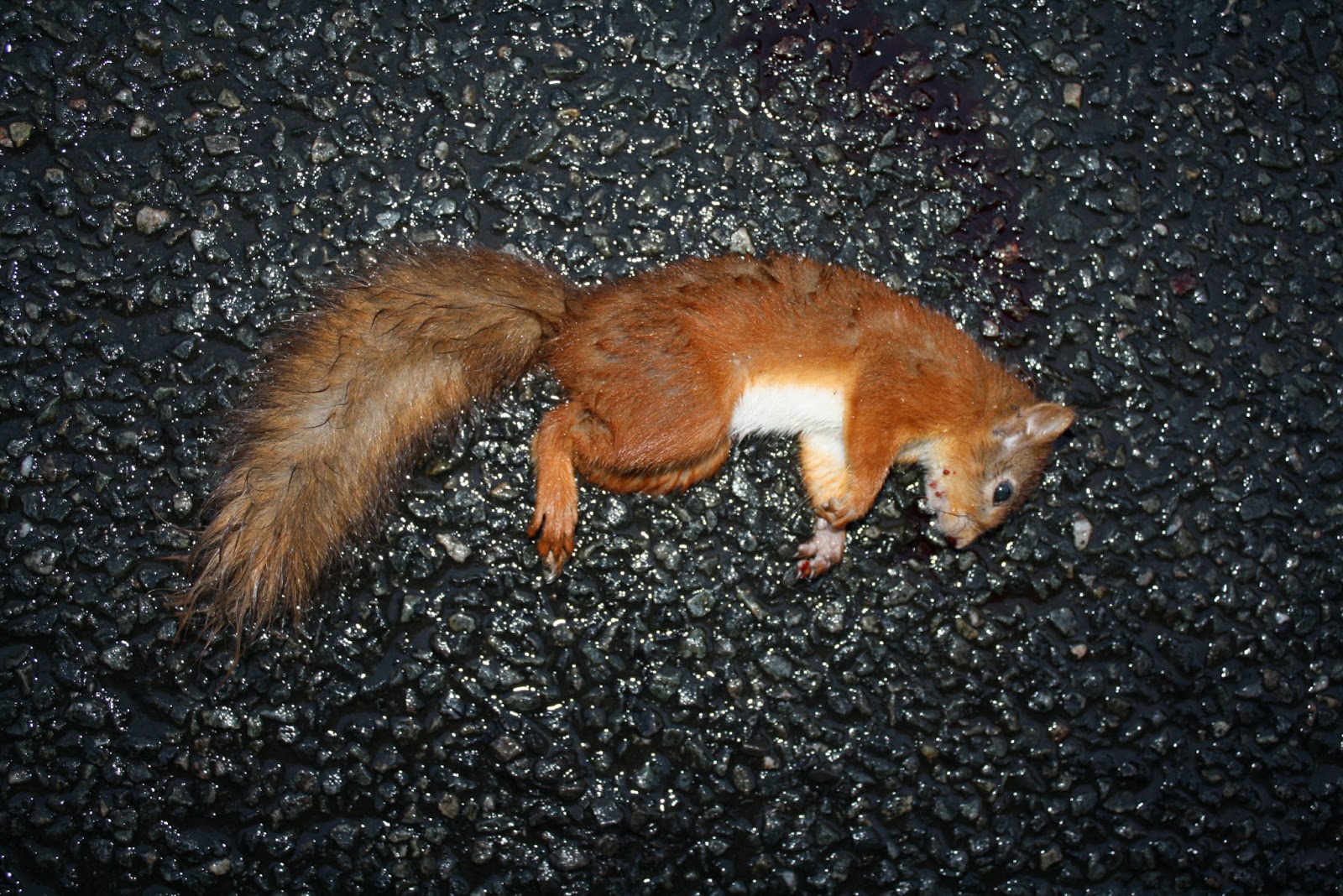
Road kill, Correl Glen, Co. Fermanagh, 13.09.2012, photo by Laurence Speight
Sources: Red Squirrel Conservation Handbook, Mourne Heritage Trust, February 2010 Controlling Grey Squirrel Damage to Woodlands, Forestry Commission, August 2007 Wicklow Mountains National Park: www.wicklowmountainsnationalpark.com The Irish Squirrel & Pine Martin Project: www.woodlandmammals.com
Tuesday, 1 January 2013
New Year's resolutions
If your resolutions for the New Year include working to make our world a more peaceful, just and healthy one, why not join the Green Party? The Fermanagh and South Tyrone consitituency group meets every month in the bar of the Horseshoe and Saddlers pub in Enniskillen for informal conversation and sharing of ideas about the issues which really matter in the world today. Our next meeting will be on Thursday 17th January at 6pm and we look forward to seeing you there. For further information, please email tanya@crystalbard.com. Oh, and a very happy new year to you all.
Reasons to be ... less than cheerful
Some sobering seasonal thoughts from Laurence
Cause for Despair
Although there is much to
celebrate, find wondrous and joyful in today’s world,
human folly, cruelty and greed lead one to despair. A case in point is the war
in the Congo in which an estimated 5 million people, mostly hard working impoverished
villagers have been killed since the 1994 genocide in Rwanda. The brutality
meted out by soldiers of the various armies on civilians, in particular women,
sickens. The war gives weight to the William Golding idea that given the
circumstances human beings will inflict pain and suffering on others without
measure. By all accounts depravity has triumphed in the Congo.
Another cause for despair is that
hubris, rather than empathy, determines how we
interact with the environment. Since the publication of Rachel Carson’s book
Silent Spring in 1962 the billions of words spoken and written about the ruin
our consumer culture wreaks on the fragile web of life has not brought about a
decline on our reliance on fossil fuels, mono crops and general wastefulness.
Our megaphone morality does not prevent the
forced displacement of indigenous peoples from lands in which they have lived
in environmentally sustainable ways for generations. In almost all cases the
hand behind their expulsion is big business and financial speculators who want
unfettered access to trees, soil, water and minerals.
The complicated nature of the
global political and economic order enables the affluent to use the bounty
gouged from the natural environment with a clear conscience. Ecocide and abuse
of the poor are inextricably
bound-up with our much-loved electronic devices, cosmetics and food. The war in
the Congo, mainly in the eastern part of the country, is driven more by the
desire of competing interests to control its enormous mineral wealth than by
ethnic rivalries or political ideology.
The Congo has deposits of gold,
tin, tungsten, tantalum, copper, coltan and cobalt worth trillions of dollars.
The country holds 70 percent of the world’s supply of tantalum, a metal used in
mobile phones, tablets, i-Pods, laptops and other electronics. The purchase of these goods wrapped now in
Christmas tinsel pays for the bullets and boots of the armies in the Congo.
Tin is another vital component of
electronic goods. Kate Hodal informs us in The Guardian Weekend, 24 November
that mining tin on Bangka Island, east of Sumatra “has scarred the island’s landscape, bulldozed its farms and forests,
killed off its fish stocks and coral reefs ... The damage is best seen from the
air, as pockets of lush forest huddle amid huge swaths of barren orange earth,
this is pockmarked with graves, many holding the bodies of miners who have died
over the centuries digging for tin. Encircling the island are the dredgers and
the suction ships and the thousands of illegal pontoons sucking up ore from the
seabed like mechanised mosquitoes.”
Hodal’s account describes in
microcosm what we are doing to the whole planet in pursuit of what we imagine
to be the good life. In an article on Climate Change in New Scientist, 17 November,
Steven Sherwood, an atmospheric scientist at the University of New South Wales
in Sydney, is quoted as saying that if we “fully
‘develop’ all of the world’s coal, tar sands, shales and other fossil fuels we
run a high risk of ending up in a few generations with a largely unliveable
planet.”
The idea that in a few
generations the Earth may no longer be the home of humankind, and other
life-forms, is frightening. Yet the evidence suggests this is precisely the
course we are set upon with governments giving more subsidies to fossil fuels
than to renewable sources of energy, sanctioning the death of the seas and the
loss of biodiversity. The building of the Belo Monte Dam in the Brazilian
Amazon and Brazil’s recently enacted Forest Code, the latter will have global
environmental consequences, vividly illustrates our relationship with the
Earth, which is trashing it for trifles.
The 2012 end of year report card
on humankind’s relationship with the environment and action on justice issues fills me with despair.
Wishing all our readers a happy
Christmas.
Laurence Speight
Wednesday, 28 November 2012
Welcome to the webpage of the FAST Greens (Fermanagh and South Tyrone Green Party). You're privileged to be here right at the beginning, when it's possible to read the whole site during the time it takes to eat a small biscuit. It won't be like that for long.... The Fermanagh Greens have been established for only a few months, as the newest, and westermost group in Northern Ireland but we've got plenty of ideas, and plenty of work to do. Follow us and find out more.
Our next meeting will be held on Thursday 13th December at 6pm in the bar of the Horseshoe & Saddlers, Enniskillen. All new and potential members are very welcome.
Our next meeting will be held on Thursday 13th December at 6pm in the bar of the Horseshoe & Saddlers, Enniskillen. All new and potential members are very welcome.
Subscribe to:
Posts (Atom)